The Situation
Health Connect’s social media advertising strategy on LinkedIn aimed to reach practicing physicians — a highly specialized audience with limited time and specific content preferences. The platform served as a key channel for promoting the initiative’s 90-second medical news videos, which summarized recent research from prestigious medical journals.
Despite targeting the appropriate professional audience, the existing advertising approach was failing to generate expected engagement levels. Healthcare professionals, who represent a particularly discerning audience with high standards for content relevance and value, were not responding to the promotional materials with sufficient click-through rates to justify the marketing investment.
The Challenge
The underperforming social media advertising strategy presented several interconnected challenges:
- Low engagement metrics: Ads were failing to generate expected click-through rates from the target physician audience.
- Ineffective messaging: Existing copy focused on stating facts rather than creating compelling reasons for engagement.
- Limited visual impact: Single-image format provided minimal opportunity to capture attention or convey value proposition.
- Generic presentation: Simple format (image + follow invitation + video title) failed to differentiate content from other medical marketing materials.
- Character constraints: LinkedIn’s 225-character limit for promotional copy required maximum impact in minimal space.
- Professional audience expectations: Physicians represent a time-conscious, highly educated audience requiring sophisticated, value-driven messaging.
- Content balance: Ads needed to provide sufficient information to generate interest without revealing enough content to eliminate the need to view the full video.
My Proposed Solution
I proposed a comprehensive transformation of the social media advertising approach:
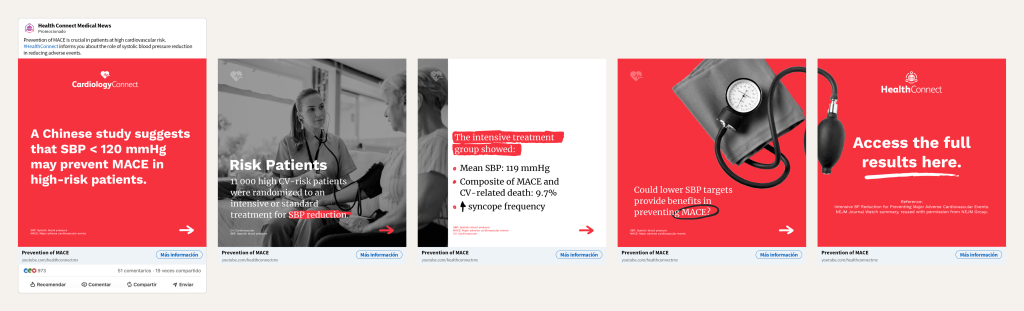
- Format evolution: Transitioned from static single-image posts to dynamic carousel formats, enabling multi-panel storytelling opportunities.
- Narrative structure: Developed story-driven content that created engagement through sequential information revelation rather than simple fact presentation.
- Strategic content teasing: Crafted carousel content that provided enough compelling information to generate interest while withholding key insights that required video viewing to obtain.
- Copy optimization: Maximized the impact of the 225-character promotional copy limit through precise, action-oriented language.
- Professional value proposition: Ensured each carousel panel contributed to a clear value proposition relevant to busy healthcare professionals.
- Sequential engagement: Designed carousel progression to maintain physician’s interest through each panel while building toward a compelling call-to-action.
Expected Results
The proposed transformation was designed to deliver several key improvements:
- Increased click-through rates: More engaging narrative format expected to generate higher engagement from the target physician audience.
- Enhanced content differentiation: The carousel storytelling approach would distinguish Health Connect ads from standard medical marketing materials.
- Improved value communication: The multi-panel format would better communicate the specific value proposition of each video.
- Stronger professional appeal: A story-driven approach designed to respect physicians’ time while providing compelling reasons for engagement.
- Optimized character usage: Strategic copy development would maximize impact within LinkedIn’s character constraints.
This proposed transformation highlighted several critical insights about marketing to specialized professional audiences. The project recognized that healthcare professionals require more sophisticated engagement strategies than simple fact-based presentations, demanding content that demonstrates clear value while respecting their time constraints. The initiative showed that platform-specific constraints, such as character limits, can be transformed from limitations into opportunities for more focused, impactful messaging when approached strategically.
This experience illustrates how content marketing optimization requires understanding both platform mechanics and audience psychology, with successful campaigns balancing technical constraints against professional engagement strategies to create more effective promotional materials.
 Ilvaíta López Rodríguez